My name is Mike Gibbons, and I am a 43-year-old singer-songwriter in Marin County, California. My Santa Cruz OM/PW and I have shared an unusual, decades-long journey together, one that Richard Hoover and the crew at SCGC asked me if I would be willing to recount.
The story begins in Philadelphia in the year 2000. I had been playing guitar for a little over a year, but I had written a handful of songs and was becoming rabidly passionate about songwriting. I was on a beginner's acoustic and needed a better instrument I could grow into. After first considering Martins and Taylors, my friend Gregory Alan Isakov - who has since become an internationally known folk artist - strongly recommended I go check out a Santa Cruz. There was only one dealer in Philadelphia carrying them at the time. I went over, became instantly smitten with a barely used OM/PW they had in stock, and they were willing to part with it for just under my $2,500 budget.
Over the next 22 years, I never bought another guitar. I played countless shows and released four full-length albums, but the most unusual thing was not how often the Santa Cruz was played - it was where. As early as 2001, my OM/PW came along for my first regular gig, performing nightly through the summer at a bamboo bar catering to backpackers in rural Laos. Having survived the tropics of Southeast Asia, I upped the stakes in 2002 with a nine-month round-the-world trip, the guitar at my side the whole way. I spent months living in the North Indian Himalayas, culminating in a ten-day trek over an 18,000-foot pass with my Calton-cased OM/PW strapped to a donkey.
Other adventures followed. I was once certain it had been stolen in Rome, when every bag from my flight had been claimed except my guitar; airport staff eventually found it lodged in the baggage tunnel, intact. Another time, living in Bangkok in 2010, I left it in the trunk of a taxi after a show. The only details I could offer were that the cab was purple and the driver wore a cowboy hat. Through a fair bit of detective work and some incredibly helpful Thai friends, I had the guitar back within 24 hours.
Then there was the time my wife Louise and I made the fateful decision to apply some ceremonial gold leaf - bought on a trip to Myanmar - to the pickguard. The adhesive that came with it was called "Burmese lacquer." After a couple of days, Louise and I both broke out in severe rashes that looked exactly like the poison oak we had had in California. The strange part: we were in Bali, where no such plant grows. After some research, we learned that urushiol, the compound in poison oak that causes the reaction, is found in only a few other plants worldwide - most notably the Burmese lacquer tree. We had, essentially, poison-oaked my guitar, and ourselves in the process. Fortunately, my friend Wayan Tuges of Blueberry Guitars in Ubud was brave and kind enough to remove all the gold leaf and offending lacquer from the instrument.
By now, the journey has carried my guitar and me to five continents and somewhere between 25 and 30 countries. For such a remarkably lightweight instrument, the OM/PW has proven astonishingly sturdy. I have put it through the wringer, and it has developed a beautifully matured tone over the decades - and I am still amazed at how well it holds tune.
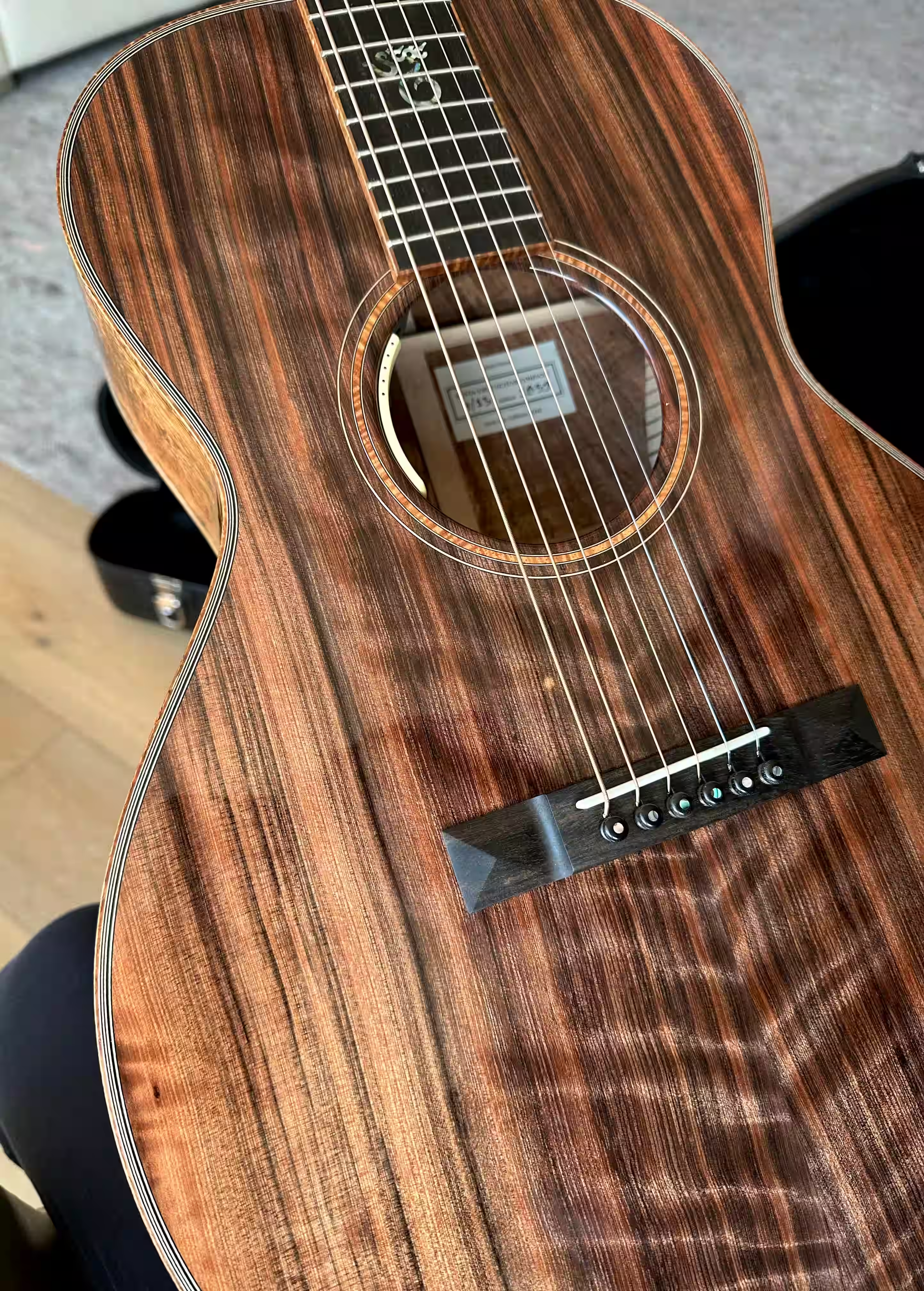
I have always called myself a monogamist where my guitar is concerned, but I recently decided it was time to add a second acoustic to pair with it. After reaching out to Santa Cruz, I opted to customize an H13 with a San Lorenzo sinker redwood top and koa back and sides. As much as I am looking forward to the new instrument, I cannot imagine my OM/PW heading into any kind of retirement. Santa Cruz guitars really are built to last a lifetime - and I wanted to share my story as a small illustration of how true that is.